Akhenaten

We know both little and much about Akhenaten—that is to say, we know enough to wish we knew much more—but at least the general contours of his biography are clear. Born Amunhotep (IV), Akhenaten ruled Egypt for a mere fourteen years (ca. 1352-1338 BCE), a relatively short reign by the standards of the day. While there is no record of his death nor have any material remains from his burial as yet come to light, it is safe to assume he died in middle age. The cause of his death is not known.
The unique and peculiar phase of Egyptian history he represents is known today as the Amarna Period—the modern Egyptian village of El-Amarna lies near the site that was once Akhenaten's capital city—although the Amarna Period extends beyond his reign, including not only Akhenaten's regency but several of his successors':
We do know about Akhenaten, in fact, probably quite a bit more than the ancient Egyptians who lived even just a few generations after the monotheist's rule. In spite of the fact that virtually no reference remains in later historical records to Akhenaten's existence, or that of his immediate successors'—it's hard to find even hints of his religion in subsequent Egyptian culture—archaeology has brought Amarna culture back to light with astounding clarity and depth. Just like Pompeii (see above, Section 1), because of its near-total obliteration more is now known about Akhenaten's regime than almost any other period during the New Kingdom of Egypt, a fact Ramses would, no doubt, not be very happy to learn.
To a large extent, our knowledge of Akhenaten's life and times begins in Akhetaten, the city he built for himself and his religion, not that the site is particularly well preserved. In fact, it's not. Later rulers antagonistic to Amarna culture, the social and religious institutions Akhenaten imposed on Egypt, intentionally destroyed Akhetaten along with the records of Akhenaten's reign. Ironically, however, that program of destruction saved the city and its founder's name for posterity, and for the most part its preservation depends on the fact that the city rose and fell very quickly. The reason for that stems from the enormous scope of change which Akhenaten attempted—a dramatic shift in religious, political and social traditions—and that meant he had to have an entirely new, fully functioning capital from which he could run the country without the weight of tradition bearing down on him and holding him back. Revolutions often have to "seize the day" and proceed quickly or else they don't get off the ground at all.
In order to build Akhenaten's city and shrines at such breakneck speed, relatively small blocks were used, stones which are now called talatat—it's easier and faster to raise a structure by using many small pieces rather than fewer large ones—and, to date, more than 45,000 talatat from Akhenaten's buildings have come to light. Indeed, so many have been recovered that today talatat can be found in museums around the world and are a regular item sold on the black market. But small-sized blocks are also easy todeconstruct. One of the reasons the Great Pyramid still stands is the enormous size of the individual stones used to build it, and in part because of that it couldn't be rapidly demolished the way Amarna culture was. It's often the case that what goes up fast comes down the same way.
Other factors played a role in the ready destruction—and preservation!—of Akhenaten's city and religion. The demolitionists who sought to obliterate any memory of Akhenaten by eradicating all traces of Amarna culture used his talatat, as fill in their own construction projects. But by hiding the talatat within the body of other buildings, they inadvertently protected and preserved them for modern archaeologists to find. Because of that, much of Akhenaten's architecture and artwork can be reconstructed. So it also works the other way around: what goes down easily comes back up the same way, too.
Akhetaten, this new hub of Aten worship, was situated along the eastern shore of the Nile in a spot which had never before been settled. That was, no doubt, part of its charm to Akhenaten—it lent the site a sense of austerity and religious purity, the very sort of newness he sought in his own regime—and unlike even the remotest Egyptian village, this locale had not as yet been connected with any cult or deity. Theologically, it was a "clean slate," so to speak. Before Akhenaten's arrival, the place had no name even, allowing the king to dub it as he liked, and the name he chose, Akhetaten, means in Egyptian "the Horizon of the Sun-disk."
And there's a good reason people had never attempted to settle this area before. Its location is near the desert, a place where it's virtually impossible to feed and house a self-sustaining populace of any real size—certainly not one large enough to govern a nation like ancient Egypt—so, maintaining the army of bureaucrats and office-workers needed to run Akhenaten's realm depended on the collection of taxes and importation of food stuffs, an expensive and labor-intensive investment of resources. But Akhenaten didn't have to worry about that. He was the pharaoh, both god and king, and as long as he lived, his will was law. If he wanted to build a castle in the sand, city hall followed.
Nor is it hard to understand why he should want a city like this, if one looks at things from his perspective. To start with, desolate locations like el-Amarna have a long history of attracting religious sectarians of Akhenaten's sort—environments like that certainly appealed to the desert fathers of early Christianity and various groups of American pioneers—all of whom have also felt at home in places distant from traditional communities and accepted practices of government and worship. Furthermore, from Akhenaten's viewpoint, Akhetaten was not without certain charms. Lodged in a recess in the highlands flanking the Nile, the site provides spectacular dawns, and indeed, at certain times of year the sun appears to rise from a yoke in the mountains which embodies beautifully the solar iconography seen in much of the artwork created during the Amarna period. All in all, it's not hard to imagine the morning Akhenaten awoke on his royal barge as he was sailing down the Nile, looking for a place to build a new city, and saw this sight, a site so suited to his solitary nature and obsession with the sun.
The second son of Amunhotep III, Akhenaten was still called Amunhotep when he succeeded his father to the throne in 1352 BCE. By all appearances, it was a smooth transition of power and, even though he had not always been the heir apparent—his older brother had been groomed for the kingship but had died several years earlier—the young Akhenaten was not unprepared to wield the crook-and-flail because,to judge from his last portraits, his father suffered a lingering malady of some sort which slowly killed him, so it would make sense that, as his health declined, he handed at least some of the reins of government to his chosen successor, even if one chosen largely by default. None of that, however, would have helped Akhenaten feel part of or indebted to the traditional structures of Egyptian government and religion in the day.
Almost as soon as Akhenaten became the sole ruler of Egypt, he began to alter the traditional presentation of the pharaoh and the ways state business was conducted. For instance, he took on a new title, "Prophet of Ra-Horakhte" ("Ra of the Horizon")—note no Amun, the god of mysteries and hidden truth whose name appears in so many Egyptian appellations, e.g. Amunhotep and Tutankhamun—"Prophet of Ra-Horakhte" hints at a certain degree of dissatisfaction with conventional religion, especially since by Akhenaten's day Amun had long been seen as the central deity in the extensive pantheon of Egyptian gods whose center of worship was Thebes, the capital city of Egypt. But soon a new day would dawn and Akhenaten would change all that.

Just two or three years into his reign, there is clear evidence that a major shift in Egyptian religion has begun. By now the pharaoh had moved the court and capital away from Thebes to Akhetaten and had adopted a new title, the name we know him by, Akhenaten which means in Egyptian "he is agreeable (Akhen-) to the sun-disk (-aten)." To have effectively removed Amun from his name seems like an all-but-open declaration of warfare against the dominant religious authority in the day, the Amun priesthood based in Thebes. And as if that weren't enough, archaeological evidence shows that around this time Akhenaten began closing down Amun temples across Egypt and even had the name Amun erased from some inscriptions. Later, he went so far as to order the word "gods" removed and changed to "god," wherever it occurred in public inscriptions. Whether or not this is monotheism by theological standards, it's certainly grammatical monotheism.
But what was Akhenaten's beef with Amun? Why did he dislike this god so intensely? Scholars have suggested it was because Amun as the god of secrets was too obscure a deity, too inaccessible to the public. Indeed, shrines to Amun are invariably situated in the middle of temple complexes, roofed and dark, where priests alone may enter and then only on special occasions. Perhaps Akhenaten wished to open up Egyptian religion to a wider clientele, not just the clergy, and so he constructed a capital which was the antithesis of Amun worship, exposed as much as possible to the full light of day, as the buildings of Akhetaten are: few roofed structures, little shade, and constant exposure to Akhenaten's true father as far as he was concerned, not Amunhotep III but the aten.
Indeed, a letter found among the remains of Akhetaten confirms exactly this. Writing to Akhenaten, the Assyrian king complains that the emissaries he sent to Egypt nearly died of sunstroke when they were attending some royal ceremony at the pharaoh's capital:
Humorous as it may be to some of us, the significance of this symbol is nevertheless profound, indeed probably revolutionary to an Egyptian of the day. The sun-worship Akhenaten was promoting surely reminded many of Old Kingdom theology, by now a millennium old, and its false but pervasive reputation for tyranny . More than one Egyptian at the time, particularly those in the Amun priesthood, must have asked themselves, "Sun disks? 'Ra of the Horizon'? What's next? A pyramid?"
But Akhenaten's movement entailed features far stranger than anything which had happened in the Old Kingdom. In fact, it looked forward more than backwards in time, at least inasmuch as the new religion prefigured a very different conception of godhead. Though the aten is sometimes depicted as having human or animal attributes, their frequent absence stands in strong contrast to standard Egyptian practice. The goddess Isis, for instance, is often shown as part-woman, part-cow, and the face of her deceased husband Osiris is sometimes painted green to demonstrate that he represents the rebirth of vegetation in the spring. But unlike either of them, Akhenaten's aten is the font of all being, which means by nature he cannot be restricted in form, and thus is almost always presented as the aptly universal and geometric solar circle. The little hands attached to his sun-rays run counter to this perception of the god and are, no doubt, a reflection of convention and popular taste.
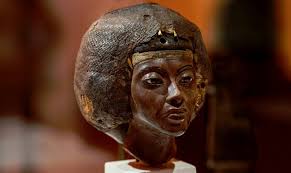
Even to say "he" of the aten is perhaps too restrictive for this universalist conception of deity—gender is clearly not relevant to sun-disks—and stranger yet, to say "he" of Akhenaten himself isn't always valid either. Male and female styles which are usually discrete in traditional Egyptian art blend together in peculiar fashion throughout Amarna culture, extending as far as royal portraiture. Akhenaten, for instance, is shown in a series of colossi (large statues; singular, colossus) lacking male genitalia, and in general, his depiction is odd, to say the least. He's often portrayed as pot-bellied, slouching, thick-lipped, with a big chin and pointed head, which has led scholars to suppose he suffered from some sort of birth defect,resulting in eunuchoidism. But if so, how did he sire a family, for in art he appears with as many as six different daughters? And those are only the ones he had by his principal wife.
That raises another fascinating and enigmatic issue concerning Akhenaten's revolution, the centrality of his family in the public presentation of his regime. Not only do we have many depictions of the beautiful Nefertiti, Akhenaten's principal wife—more, in fact, than of Akhenaten himself!—but we can trace the royal daughters' births year by year, and sadly sometimes their deaths as well. Reliefs even show the royal couple playing with the girls. Like no pharaoh before or after him, Akhenaten was family-oriented.
Thus, it seems unlikely he was a eunuch, but instead the real father of the children he professes, at least through his art, to adore so fondly. But the gender-bending portraits of him seem ill-suited for such a family man, by modern standards at least. And Nefertiti's depictions are not immune to cross-gendering, either. She's shown at least once wearing the blue crown, the helmet kings don as they go into battle. She's the only Egyptian queen ever known to have been depicted that way, including Hatshepsut, the woman who ruled Egypt singlehandedly for two decades a century before . There's something very odd, by any standard, about the way the Amarna rulers chose to portray themselves.
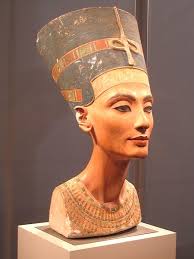
Indeed, the entire family is depicted with elongated faces and skulls, wide hips and sagging bellies. The tall hat Nefertiti wears in her famous bust is probably covering—perhaps even accentuating—her pointed head beneath, even though surely she was not congenitally deformed, and as the mother of six daughters, certainly not barren. Nor were the girls, which is all the more evidence Akhenaten also was not. Naturalistic portraiture seems a less likely explanation of the oddities inherent in this family than some sort of stylized rendering. There's doubtless something abnormal about them, but what? And why? That the royal family was the only group ever portrayed this way is surely a clue.
To depict Akhenaten's entire immediate family—and only them—in such an unusual manner must signify something. Perhaps their different look is meant to highlight exactly that, the fact that they're different. Maybe the royal family is supposed to represent something alien, transcendental, not bound to human or earthly distinctions such as gender. It's easy to see why this would appeal to Akhenaten, nor is it hard to understand why Nefertiti might go along with being designated as super-special, and the children would, of course, have been too young to have a choice or even know the difference.
All this concurs well with Akhenaten's religion, where the pharaoh was said to serve as the conduit between humanity and the aten. In other words, it's through and because of him the sun-disk bestows life on the planet. In his own words, a hymn Akhenaten claims to have composed himself about the aten, "There is no other who knows you except your son, Akhenaten." That makes the pharaoh and his family some species of divine beings among humankind, earth-bound extraterrestrials on whose good will the benefits of the sun, and thus all life, depend. One way or another, before Akhenaten's day the Egyptians had always considered the sun a god and the royal family was for the most part seen as divine, but as the only divine presence in the universe? That, indeed, was something different.
The imagery of Amarna culture with all of its strangeness has attracted not only scholars but a wide range of iconoclasts, revolutionaries and weirdos of every ilk, who have latched onto this radiant, unworldly, rebel pharaoh and more often than not caught the reflection of their own oddity in his slouching, fat-lipped silhouette. The many answers posited to the riddle of Akhenaten are, in any case, less important than the few, frail realities clinging to his reign and the questions they leave at our feet. Among them, how did he sustain such a bizarre reordering of the celestial kingdom? For more than a decade, we must remember, Akhenaten kept his divine fantasies afloat even as he faced down the Amun priesthood, traditional cults in Egypt and a nation long nurtured on a pantheon of gods numbering by that day in the thousands. Before we can ask why any of this happened or what happened to it, we must first try to understand how it happened at all.
Akhenaten must have had some supporters, besides the usual lunatic fringe and sycophant wing who will follow any maniac into the wilderness. A hint about their identity comes in one of the Amarna reliefs in which Nefertiti holds up the decapitated head of a foreign captive. That suggests some sort of military activity during Akhenaten's reign, an event history bears no evidence of otherwise. But that's not surprising really, given later pharaohs' destruction of records from this day. Any boast of victory in foreign wars the monomaniacal monotheist might have issued isn't likely to have survived their holocaust. So, if Akhenaten did have the support of the Egyptian army—and there's no real evidence to the contrary—his revolution would make much more sense. Still, an army backing an effeminate, secluded, family-loving, pointy-headed sun freak seems highly improbable by the standards of today. Then again, how much can we rely on our modern sensibilities here where so little else seems logical?
Yet, strange times often make strange bedfellows. If both the pharaoh and the military were seeking the same thing—for instance, to undercut the power of the Amun priesthood which by then was siphoning off a hefty percentage of the taxes collected in Egypt—the aten and the army might have made common cause. Or so some scholars suggest. All the same, it must have been an interesting meeting between the slouching sun-lover and the hardened desert troopers who defended Egypt's frontier. How did they find enough in common even to have a conversation, much less foment a revolution together?
We know both little and much about Akhenaten—that is to say, we know enough to wish we knew much more—but at least the general contours of his biography are clear. Born Amunhotep (IV), Akhenaten ruled Egypt for a mere fourteen years (ca. 1352-1338 BCE), a relatively short reign by the standards of the day. While there is no record of his death nor have any material remains from his burial as yet come to light, it is safe to assume he died in middle age. The cause of his death is not known.
The unique and peculiar phase of Egyptian history he represents is known today as the Amarna Period—the modern Egyptian village of El-Amarna lies near the site that was once Akhenaten's capital city—although the Amarna Period extends beyond his reign, including not only Akhenaten's regency but several of his successors':
• Smenkhare (1338-1336 BCE), about whom next to nothing is known;By the time the next series of pharaohs held the throne—Horemheb (1323-1295 BCE) and the Ramessids, a dynasty that included the famous Ramses II—the site near Amarna had been abandoned and destroyed, along with the memory of Akhenaten's religion in the general conscience of the ancient Egyptian public. This deliberate attempt to eradicate all reference in the Egyptian record to the Amarna period was nearly successful, but not quite.
• Tutankhuaten (later, Tutankhamun ["King Tut"], 1336-1327 BCE), whose current notoriety since the discovery of his tomb in the 1920's far outstrips the boy-king's renown in antiquity;
• and finally the very elderly Ay (1327-1323 BCE).
We do know about Akhenaten, in fact, probably quite a bit more than the ancient Egyptians who lived even just a few generations after the monotheist's rule. In spite of the fact that virtually no reference remains in later historical records to Akhenaten's existence, or that of his immediate successors'—it's hard to find even hints of his religion in subsequent Egyptian culture—archaeology has brought Amarna culture back to light with astounding clarity and depth. Just like Pompeii (see above, Section 1), because of its near-total obliteration more is now known about Akhenaten's regime than almost any other period during the New Kingdom of Egypt, a fact Ramses would, no doubt, not be very happy to learn.
A. Akhetaten (Akhenaten's capital)
To a large extent, our knowledge of Akhenaten's life and times begins in Akhetaten, the city he built for himself and his religion, not that the site is particularly well preserved. In fact, it's not. Later rulers antagonistic to Amarna culture, the social and religious institutions Akhenaten imposed on Egypt, intentionally destroyed Akhetaten along with the records of Akhenaten's reign. Ironically, however, that program of destruction saved the city and its founder's name for posterity, and for the most part its preservation depends on the fact that the city rose and fell very quickly. The reason for that stems from the enormous scope of change which Akhenaten attempted—a dramatic shift in religious, political and social traditions—and that meant he had to have an entirely new, fully functioning capital from which he could run the country without the weight of tradition bearing down on him and holding him back. Revolutions often have to "seize the day" and proceed quickly or else they don't get off the ground at all.
In order to build Akhenaten's city and shrines at such breakneck speed, relatively small blocks were used, stones which are now called talatat—it's easier and faster to raise a structure by using many small pieces rather than fewer large ones—and, to date, more than 45,000 talatat from Akhenaten's buildings have come to light. Indeed, so many have been recovered that today talatat can be found in museums around the world and are a regular item sold on the black market. But small-sized blocks are also easy todeconstruct. One of the reasons the Great Pyramid still stands is the enormous size of the individual stones used to build it, and in part because of that it couldn't be rapidly demolished the way Amarna culture was. It's often the case that what goes up fast comes down the same way.
Other factors played a role in the ready destruction—and preservation!—of Akhenaten's city and religion. The demolitionists who sought to obliterate any memory of Akhenaten by eradicating all traces of Amarna culture used his talatat, as fill in their own construction projects. But by hiding the talatat within the body of other buildings, they inadvertently protected and preserved them for modern archaeologists to find. Because of that, much of Akhenaten's architecture and artwork can be reconstructed. So it also works the other way around: what goes down easily comes back up the same way, too.
Akhetaten, this new hub of Aten worship, was situated along the eastern shore of the Nile in a spot which had never before been settled. That was, no doubt, part of its charm to Akhenaten—it lent the site a sense of austerity and religious purity, the very sort of newness he sought in his own regime—and unlike even the remotest Egyptian village, this locale had not as yet been connected with any cult or deity. Theologically, it was a "clean slate," so to speak. Before Akhenaten's arrival, the place had no name even, allowing the king to dub it as he liked, and the name he chose, Akhetaten, means in Egyptian "the Horizon of the Sun-disk."
And there's a good reason people had never attempted to settle this area before. Its location is near the desert, a place where it's virtually impossible to feed and house a self-sustaining populace of any real size—certainly not one large enough to govern a nation like ancient Egypt—so, maintaining the army of bureaucrats and office-workers needed to run Akhenaten's realm depended on the collection of taxes and importation of food stuffs, an expensive and labor-intensive investment of resources. But Akhenaten didn't have to worry about that. He was the pharaoh, both god and king, and as long as he lived, his will was law. If he wanted to build a castle in the sand, city hall followed.
Nor is it hard to understand why he should want a city like this, if one looks at things from his perspective. To start with, desolate locations like el-Amarna have a long history of attracting religious sectarians of Akhenaten's sort—environments like that certainly appealed to the desert fathers of early Christianity and various groups of American pioneers—all of whom have also felt at home in places distant from traditional communities and accepted practices of government and worship. Furthermore, from Akhenaten's viewpoint, Akhetaten was not without certain charms. Lodged in a recess in the highlands flanking the Nile, the site provides spectacular dawns, and indeed, at certain times of year the sun appears to rise from a yoke in the mountains which embodies beautifully the solar iconography seen in much of the artwork created during the Amarna period. All in all, it's not hard to imagine the morning Akhenaten awoke on his royal barge as he was sailing down the Nile, looking for a place to build a new city, and saw this sight, a site so suited to his solitary nature and obsession with the sun.
B. Akhenaten's Early Reign (1352-1348 BCE)How that obsession developed and, in general, the path which led to this point in his career are not difficult to reconstruct, either. Although the earliest stages of Akhenaten's life reveal few overt signs of the religious revolution on the horizon, there are several significant hints as to the radical changes about to sunburn Egypt. Even if the clarity of hindsight sometimes makes things look predictable when they're not, these omens are truly telling.
The second son of Amunhotep III, Akhenaten was still called Amunhotep when he succeeded his father to the throne in 1352 BCE. By all appearances, it was a smooth transition of power and, even though he had not always been the heir apparent—his older brother had been groomed for the kingship but had died several years earlier—the young Akhenaten was not unprepared to wield the crook-and-flail because,to judge from his last portraits, his father suffered a lingering malady of some sort which slowly killed him, so it would make sense that, as his health declined, he handed at least some of the reins of government to his chosen successor, even if one chosen largely by default. None of that, however, would have helped Akhenaten feel part of or indebted to the traditional structures of Egyptian government and religion in the day.
Almost as soon as Akhenaten became the sole ruler of Egypt, he began to alter the traditional presentation of the pharaoh and the ways state business was conducted. For instance, he took on a new title, "Prophet of Ra-Horakhte" ("Ra of the Horizon")—note no Amun, the god of mysteries and hidden truth whose name appears in so many Egyptian appellations, e.g. Amunhotep and Tutankhamun—"Prophet of Ra-Horakhte" hints at a certain degree of dissatisfaction with conventional religion, especially since by Akhenaten's day Amun had long been seen as the central deity in the extensive pantheon of Egyptian gods whose center of worship was Thebes, the capital city of Egypt. But soon a new day would dawn and Akhenaten would change all that.
C. The Middle and End of Akhenaten's Reign (1348-1338 BCE)
Just two or three years into his reign, there is clear evidence that a major shift in Egyptian religion has begun. By now the pharaoh had moved the court and capital away from Thebes to Akhetaten and had adopted a new title, the name we know him by, Akhenaten which means in Egyptian "he is agreeable (Akhen-) to the sun-disk (-aten)." To have effectively removed Amun from his name seems like an all-but-open declaration of warfare against the dominant religious authority in the day, the Amun priesthood based in Thebes. And as if that weren't enough, archaeological evidence shows that around this time Akhenaten began closing down Amun temples across Egypt and even had the name Amun erased from some inscriptions. Later, he went so far as to order the word "gods" removed and changed to "god," wherever it occurred in public inscriptions. Whether or not this is monotheism by theological standards, it's certainly grammatical monotheism.
But what was Akhenaten's beef with Amun? Why did he dislike this god so intensely? Scholars have suggested it was because Amun as the god of secrets was too obscure a deity, too inaccessible to the public. Indeed, shrines to Amun are invariably situated in the middle of temple complexes, roofed and dark, where priests alone may enter and then only on special occasions. Perhaps Akhenaten wished to open up Egyptian religion to a wider clientele, not just the clergy, and so he constructed a capital which was the antithesis of Amun worship, exposed as much as possible to the full light of day, as the buildings of Akhetaten are: few roofed structures, little shade, and constant exposure to Akhenaten's true father as far as he was concerned, not Amunhotep III but the aten.
Indeed, a letter found among the remains of Akhetaten confirms exactly this. Writing to Akhenaten, the Assyrian king complains that the emissaries he sent to Egypt nearly died of sunstroke when they were attending some royal ceremony at the pharaoh's capital:
Why are my messengers kept in the open sun? They will die in the open sun. If it does the king good to stand in the open sun, then let the king stand there and die in the open sun.The heat of the Egyptian midday is, in fact, torturous through much of the year, but standing in the sun and basking in its brilliance is also a natural extension of Akhenaten's religious revolution, something virtually all the art of Amarna culture demonstrates. And this is very different from the way Amun was worshiped, surely an advantage in Akhenaten's mind. It may even help to explain Akhenaten's premature death: skin cancer?
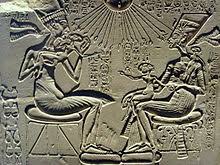
D. Art and Iconography in Akhenaten's ReignThe religious iconography of Akhenaten's new belief system centered around the aten as a divine presence. Representing the life-giving force of the universe, the sun-disk is often depicted in either abstract or personified form, occasionally both at the same time. Though it's most often pictured as a mere circle with rays of light radiating downward, the aten also appears sometimes with little hands appended onto the ends of its solar beams holding out to worshipers the ankh, the Egyptian sign of life. In a few instances, the hands are even shoving the ankh rather unceremoniously up the noses of the blessed, a figurative assertion, no doubt, that the sun offers the "breath of life." It would seem less comical today if this sacrament didn't look so much like an incontinent ear-swab.
Humorous as it may be to some of us, the significance of this symbol is nevertheless profound, indeed probably revolutionary to an Egyptian of the day. The sun-worship Akhenaten was promoting surely reminded many of Old Kingdom theology, by now a millennium old, and its false but pervasive reputation for tyranny . More than one Egyptian at the time, particularly those in the Amun priesthood, must have asked themselves, "Sun disks? 'Ra of the Horizon'? What's next? A pyramid?"
But Akhenaten's movement entailed features far stranger than anything which had happened in the Old Kingdom. In fact, it looked forward more than backwards in time, at least inasmuch as the new religion prefigured a very different conception of godhead. Though the aten is sometimes depicted as having human or animal attributes, their frequent absence stands in strong contrast to standard Egyptian practice. The goddess Isis, for instance, is often shown as part-woman, part-cow, and the face of her deceased husband Osiris is sometimes painted green to demonstrate that he represents the rebirth of vegetation in the spring. But unlike either of them, Akhenaten's aten is the font of all being, which means by nature he cannot be restricted in form, and thus is almost always presented as the aptly universal and geometric solar circle. The little hands attached to his sun-rays run counter to this perception of the god and are, no doubt, a reflection of convention and popular taste.
Even to say "he" of the aten is perhaps too restrictive for this universalist conception of deity—gender is clearly not relevant to sun-disks—and stranger yet, to say "he" of Akhenaten himself isn't always valid either. Male and female styles which are usually discrete in traditional Egyptian art blend together in peculiar fashion throughout Amarna culture, extending as far as royal portraiture. Akhenaten, for instance, is shown in a series of colossi (large statues; singular, colossus) lacking male genitalia, and in general, his depiction is odd, to say the least. He's often portrayed as pot-bellied, slouching, thick-lipped, with a big chin and pointed head, which has led scholars to suppose he suffered from some sort of birth defect,resulting in eunuchoidism. But if so, how did he sire a family, for in art he appears with as many as six different daughters? And those are only the ones he had by his principal wife.
That raises another fascinating and enigmatic issue concerning Akhenaten's revolution, the centrality of his family in the public presentation of his regime. Not only do we have many depictions of the beautiful Nefertiti, Akhenaten's principal wife—more, in fact, than of Akhenaten himself!—but we can trace the royal daughters' births year by year, and sadly sometimes their deaths as well. Reliefs even show the royal couple playing with the girls. Like no pharaoh before or after him, Akhenaten was family-oriented.
Thus, it seems unlikely he was a eunuch, but instead the real father of the children he professes, at least through his art, to adore so fondly. But the gender-bending portraits of him seem ill-suited for such a family man, by modern standards at least. And Nefertiti's depictions are not immune to cross-gendering, either. She's shown at least once wearing the blue crown, the helmet kings don as they go into battle. She's the only Egyptian queen ever known to have been depicted that way, including Hatshepsut, the woman who ruled Egypt singlehandedly for two decades a century before . There's something very odd, by any standard, about the way the Amarna rulers chose to portray themselves.
Indeed, the entire family is depicted with elongated faces and skulls, wide hips and sagging bellies. The tall hat Nefertiti wears in her famous bust is probably covering—perhaps even accentuating—her pointed head beneath, even though surely she was not congenitally deformed, and as the mother of six daughters, certainly not barren. Nor were the girls, which is all the more evidence Akhenaten also was not. Naturalistic portraiture seems a less likely explanation of the oddities inherent in this family than some sort of stylized rendering. There's doubtless something abnormal about them, but what? And why? That the royal family was the only group ever portrayed this way is surely a clue.
To depict Akhenaten's entire immediate family—and only them—in such an unusual manner must signify something. Perhaps their different look is meant to highlight exactly that, the fact that they're different. Maybe the royal family is supposed to represent something alien, transcendental, not bound to human or earthly distinctions such as gender. It's easy to see why this would appeal to Akhenaten, nor is it hard to understand why Nefertiti might go along with being designated as super-special, and the children would, of course, have been too young to have a choice or even know the difference.
All this concurs well with Akhenaten's religion, where the pharaoh was said to serve as the conduit between humanity and the aten. In other words, it's through and because of him the sun-disk bestows life on the planet. In his own words, a hymn Akhenaten claims to have composed himself about the aten, "There is no other who knows you except your son, Akhenaten." That makes the pharaoh and his family some species of divine beings among humankind, earth-bound extraterrestrials on whose good will the benefits of the sun, and thus all life, depend. One way or another, before Akhenaten's day the Egyptians had always considered the sun a god and the royal family was for the most part seen as divine, but as the only divine presence in the universe? That, indeed, was something different.
The imagery of Amarna culture with all of its strangeness has attracted not only scholars but a wide range of iconoclasts, revolutionaries and weirdos of every ilk, who have latched onto this radiant, unworldly, rebel pharaoh and more often than not caught the reflection of their own oddity in his slouching, fat-lipped silhouette. The many answers posited to the riddle of Akhenaten are, in any case, less important than the few, frail realities clinging to his reign and the questions they leave at our feet. Among them, how did he sustain such a bizarre reordering of the celestial kingdom? For more than a decade, we must remember, Akhenaten kept his divine fantasies afloat even as he faced down the Amun priesthood, traditional cults in Egypt and a nation long nurtured on a pantheon of gods numbering by that day in the thousands. Before we can ask why any of this happened or what happened to it, we must first try to understand how it happened at all.
Akhenaten must have had some supporters, besides the usual lunatic fringe and sycophant wing who will follow any maniac into the wilderness. A hint about their identity comes in one of the Amarna reliefs in which Nefertiti holds up the decapitated head of a foreign captive. That suggests some sort of military activity during Akhenaten's reign, an event history bears no evidence of otherwise. But that's not surprising really, given later pharaohs' destruction of records from this day. Any boast of victory in foreign wars the monomaniacal monotheist might have issued isn't likely to have survived their holocaust. So, if Akhenaten did have the support of the Egyptian army—and there's no real evidence to the contrary—his revolution would make much more sense. Still, an army backing an effeminate, secluded, family-loving, pointy-headed sun freak seems highly improbable by the standards of today. Then again, how much can we rely on our modern sensibilities here where so little else seems logical?
Yet, strange times often make strange bedfellows. If both the pharaoh and the military were seeking the same thing—for instance, to undercut the power of the Amun priesthood which by then was siphoning off a hefty percentage of the taxes collected in Egypt—the aten and the army might have made common cause. Or so some scholars suggest. All the same, it must have been an interesting meeting between the slouching sun-lover and the hardened desert troopers who defended Egypt's frontier. How did they find enough in common even to have a conversation, much less foment a revolution together?

No comments:
Post a Comment